
In the kitchens of many universities, terrazzo flooring was once synonymous with sturdiness and durability. However, as time passed and usage intensity increased, these once-glossy floors gradually revealed problems: the surface was worn abnormally smooth, and after cleaning the wet and slippery floor became a safety hazard; long-term high temperature and oil erosion caused micro pores and cracks in the terrazzo surface, into which oil stains penetrated — not only difficult to clean thoroughly, but also breeding large amounts of bacteria and threatening food safety. In addition, local hollowing and cracking also occurred from time to time, with a hollow sound when knocked, indicating damage to the floor structure.
Traditional renovation methods such as demolition and rebuilding are huge projects with severe dust pollution and long-term disruption to normal canteen operation, which is almost unacceptable for personnel-intensive schools. Facing these tricky pain points, a more advanced and efficient renovation technology has emerged — applying high-performance floor coatings directly on the old terrazzo floor. Among them, the coating solution of high-penetration epoxy primer + mortar intermediate layer + polyurethane ultra-wear-resistant topcoat provided by Hubei FLDC Coatings is the “golden combination” for solving the renovation problem of terrazzo floors in school canteen kitchens. This solution does not require destroying the original floor and can be applied directly on professionally treated terrazzo substrate, achieving “old floor renewal”.
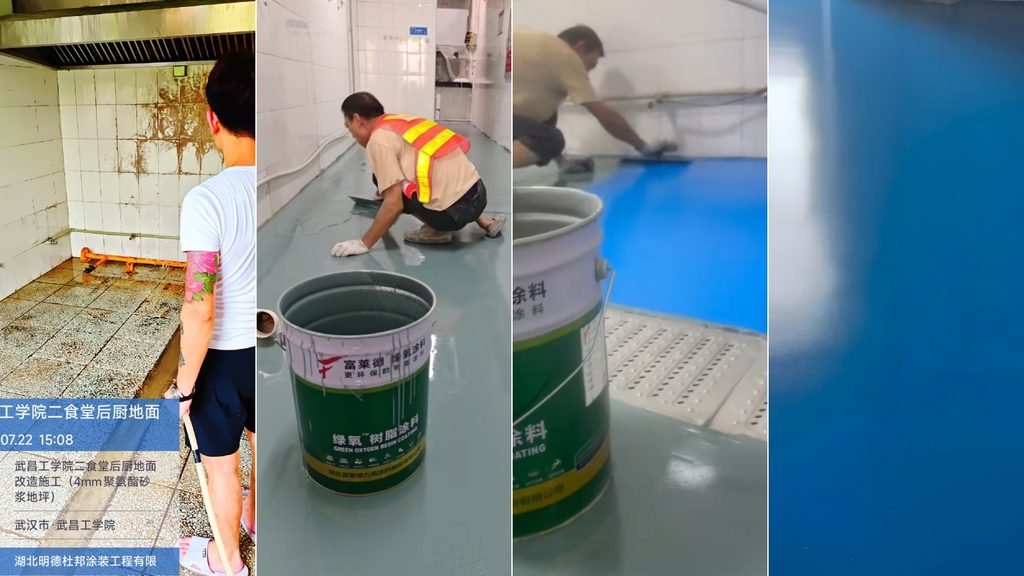
Step 1: High-Penetration Epoxy Primer — Anchoring the Substrate Like Roots
To solve the problem of smooth terrazzo surface and poor adhesion, FLDC’s high-penetration epoxy primer plays a key role. With extremely low viscosity and strong penetration ability, it penetrates into the capillary pores and micro cracks of terrazzo and forms a firm whole with the substrate. This not only greatly enhances the adhesion of subsequent coatings to terrazzo and prevents risks of delamination and peeling later, but also effectively seals the floor and eliminates topcoat “blooming” caused by terrazzo alkali return, laying a solid foundation for the entire coating system.
Step 2: Mortar Intermediate Layer — 2-3mm Tough Compressive Layer Against “Physical Attack”
After solving the adhesion problem, the next step is to cope with the “physical attack” on the kitchen floor — frequent pushing and pulling, heavy object impact and equipment movement. The mortar intermediate layer is made of high-strength epoxy resin mixed with selected quartz sand / quartz powder. Through troweling or scraping, it forms a tough compressive layer up to 2-3mm thick. It not only perfectly fills the original cracks, holes and unevenness of terrazzo and restores floor flatness, but more importantly endows the floor with excellent compressive, impact and wear resistance, ensuring the floor remains like new even in the busiest kitchen environment, without cracking or damage.
Step 3: Polyurethane Ultra-Wear-Resistant Topcoat — Three Core Advantages for User Experience and Food Safety
As the “protective outer coat” of the floor, the polyurethane ultra-wear-resistant topcoat has three core advantages:
- Extreme anti-slip performance: By finely controlling the amount of anti-slip aggregate during construction, the floor’s anti-slip coefficient can be precisely adjusted, providing reliable friction even in oily and wet environments and fundamentally eliminating slip accidents.
- Seamless and easy to clean: After curing, the polyurethane topcoat forms a dense, non-porous surface. Oil stains, soy sauce, soup and other stains cannot penetrate; daily cleaning only requires a gentle wipe with water and ordinary detergent to restore a glossy finish, greatly reducing the burden on cleaning staff and achieving extremely high hygiene standards.
- Long-lasting durability: Polyurethane material is known for its excellent weather resistance, yellowing resistance and chemical corrosion resistance. It can resist common acid, alkali, salt, detergents and high-temperature steam in the kitchen, ensuring the floor maintains its appearance and functionality over the long term, with a service life far exceeding traditional floors.
Overall Value of the Solution
The renovation solution customized by FLDC for terrazzo floors in school canteen kitchens progresses layer by layer from substrate treatment to surface protection, with every link closely connected. It not only perfectly solves the pain points of old terrazzo floors — smooth, easy to get dirty, easy to damage and unsafe — but also minimizes the impact on canteen operation thanks to convenient, fast and dust-free construction.
For users looking for solutions such as school canteen kitchen floor renovation, terrazzo floor transformation and canteen anti-slip flooring, choosing FLDC means choosing a safe, efficient, durable and highly cost-effective upgrade.